On this page

Physician-led aesthetic care means a doctor reviews and signs off on every treatment plan — the device, the dose, the depth — before a patient enters the treatment room, rather than a plan being set verbally at a front desk or built around a promotion. In practice, this looks like a written protocol behind each case, logged in advance, not a mood or a quote given on the spot. It is a structural difference in how a clinic operates, not a marketing phrase.
You’ve read three reviews and scrolled through a dozen before-and-afters, and you still can’t tell whether a doctor actually designed the plan you’re about to pay for, or whether a price list did. That uncertainty is reasonable. Most clinics don’t make the difference visible, because most of it happens before you ever sit down.
What Does “Physician-Led” Actually Mean In Practice?
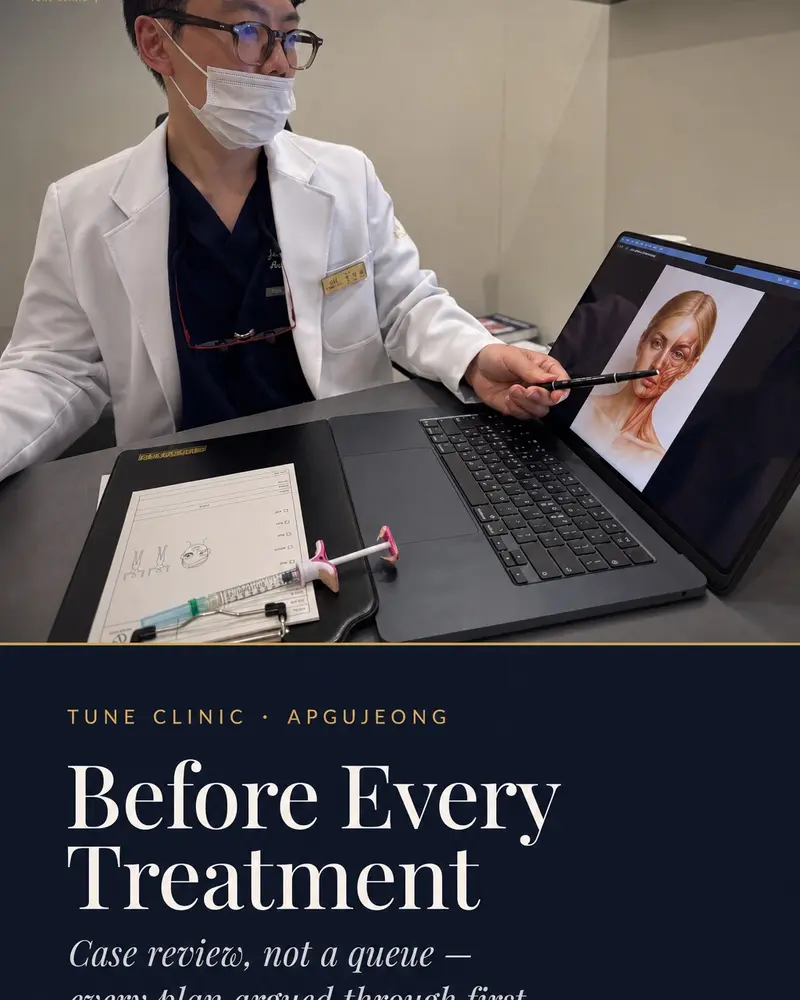
It means the case is argued through in a review — not simply booked, priced, and executed. In our clinic, every new case is discussed among the treating physicians before a plan is finalized, including cases that look routine on paper.
This matters because two patients asking for the same treatment rarely need the same plan. Skin quality, bone structure, prior filler or thread history, and how a face moves when it speaks all change what a sound plan looks like. A physician-led process is the mechanism that catches this before it becomes a problem in the room.
Why Do So Many Clinics Compete On Price Instead Of Protocol?
Because price is the easiest lever to pull when a clinic has no clinical standard to compete on instead. When protocol is not written down, the plan is negotiable — dosage, depth, and device settings shift to match a budget rather than an anatomy.
This is where judgment gets rushed. A discounted session still has to hit a schedule, and if the plan was never fixed in writing, it bends to fit the slot rather than the patient.
A protocol is not a formality. It’s the thing that stops a plan from quietly shrinking to fit a discount.
What Happens Before A Patient Even Enters The Treatment Room?
Before any device is switched on, the case has already been reviewed, the protocol has already been written, and the instrument tray has already been checked against that specific plan — not a generic setup for the day.
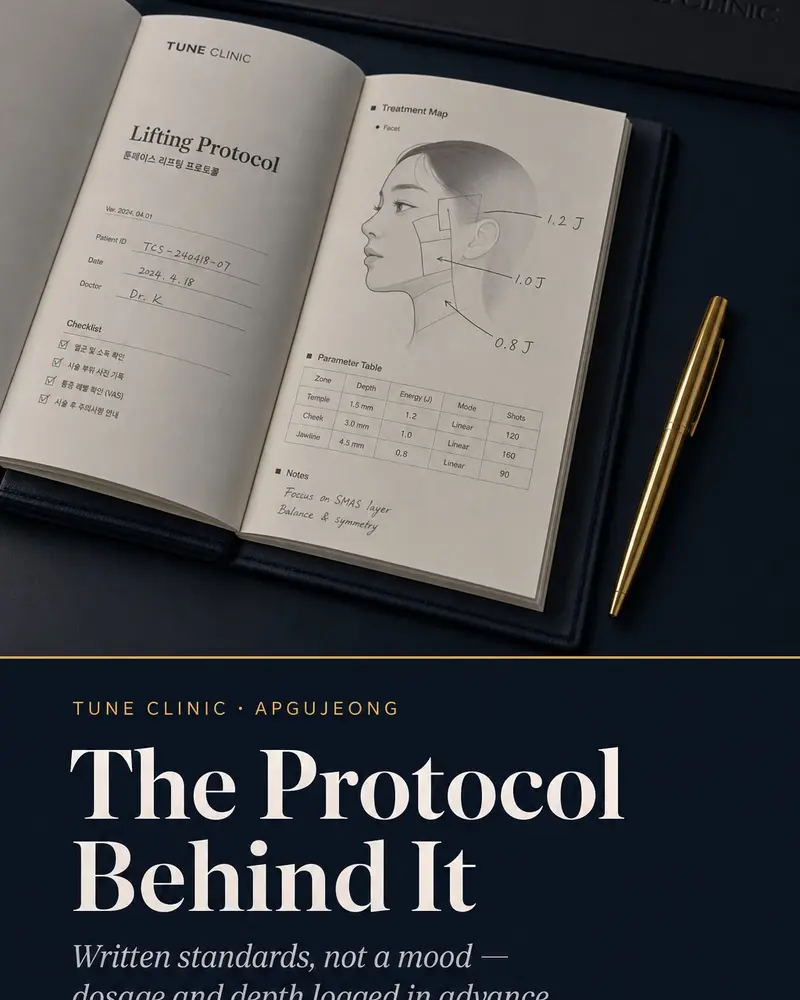
The Written Protocol
A protocol is not a verbal estimate. It specifies the device, the dosage or depth setting, the sequence if multiple treatments are combined, and the rationale for choosing that combination over alternatives. For a lifting case, for example, this might mean a documented decision between Ultherapy and Oligio — a monopolar radiofrequency device — based on where laxity actually sits, not on which device happens to be on promotion that week. We go into how that kind of decision gets made on our physician-led design page.
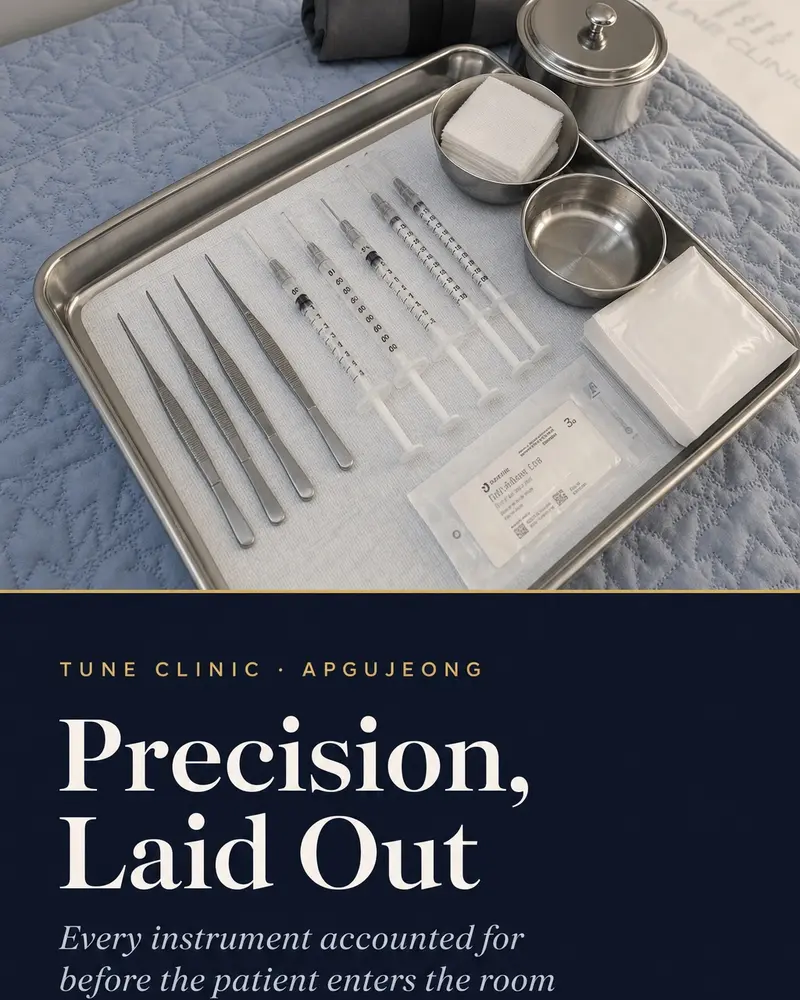
The instrument tray reflects the same discipline. Every needle gauge, cannula, and device tip is accounted for before the patient enters, matched to the written plan rather than assembled on the fly.
Why Does Clinic Ownership Matter To The Patient?
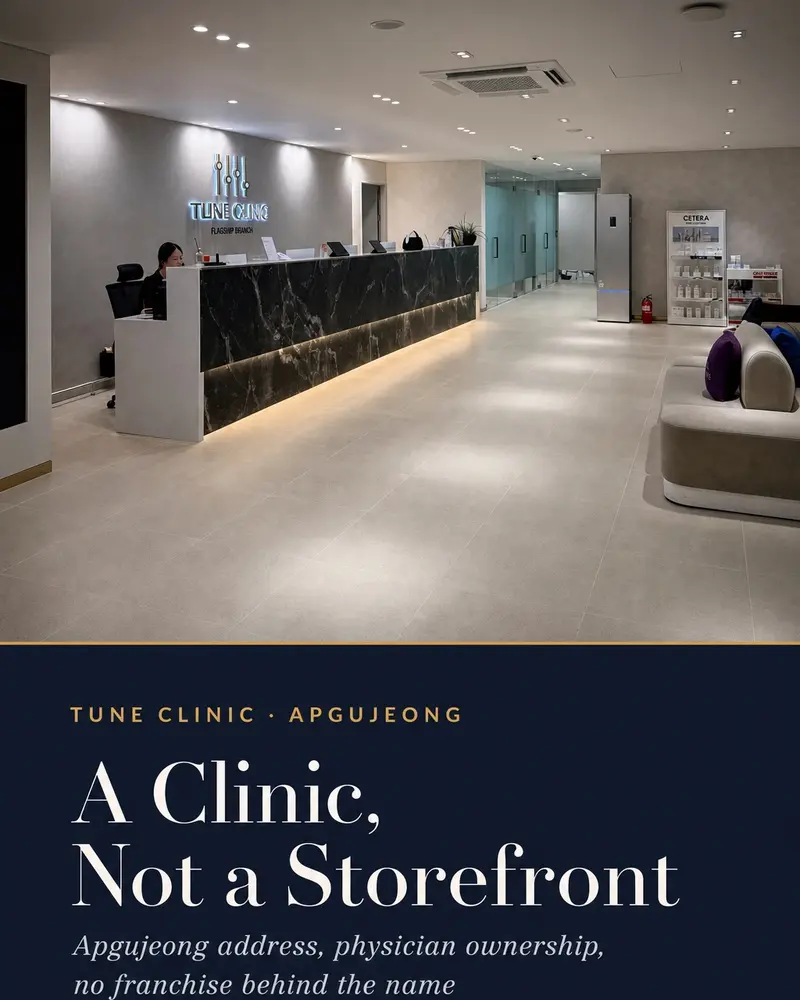
Ownership structure matters because it determines who is accountable for the standard. A single Apgujeong address under direct physician ownership means the doctors reviewing your case are the same doctors accountable for the outcome — there is no franchise layer setting quotas or discount schedules from elsewhere.
This doesn’t make outcomes uniform or guaranteed. It means the incentive structure runs toward getting the plan right rather than toward volume.
What Physician-Led Care Does Not Guarantee
A physician-led model is not a promise of a specific result, and it is not automatically the right fit for every patient’s budget or timeline. Some patients want a fast, low-cost session for a minor concern, and a full case review may be more process than the concern warrants — that’s a reasonable trade-off to discuss openly, not a failure of the model.
Sometimes the answer coming out of a case review is to do less than what was asked for, or to wait. A written protocol that recommends restraint is still doing its job.
FAQ
What does “physician-led” mean at an aesthetic clinic?
It means a doctor reviews and approves the treatment plan — the specific device, dosage, and depth — before treatment begins, with that plan documented in writing rather than decided verbally or adjusted to fit a discount or a schedule slot.
Is a physician-led clinic more expensive than a discount clinic?
Often, yes, because protocol review and instrument preparation take physician time that a discount-driven model skips. The cost difference reflects process, not markup — the plan is built around the patient’s anatomy rather than around filling a booking slot.
Does physician-led care guarantee better results?
No. It reduces the chance that a plan was rushed or mismatched to the patient, but outcomes still depend on individual anatomy, skin quality, and healing. A sound protocol is a precondition for a good outcome, not a guarantee of one.
How can a patient tell if a clinic actually follows a written protocol?
Ask directly during consultation what device, dosage, or depth is planned and why, and whether that plan was reviewed by a physician beforehand. A clinic following a real protocol can answer specifically; one that cannot will usually default to general reassurance instead.
Do I need an appointment for a physician case review, or can I just walk in?
A proper case review requires a scheduled consultation, since it involves assessing your specific anatomy and history before any protocol is written. English-language consultations at our Apgujeong location are scheduled in advance for exactly this reason.
Ready to plan your treatment?
Tune Clinic Apgujeong offers English-language consultations with Dr. Ju and Dr. Cha — a structured assessment, not a sales call.
→Book an appointmentto pick a time that fits your Seoul itinerary.
→Message us on WhatsAppto ask in English before you commit.