On this page
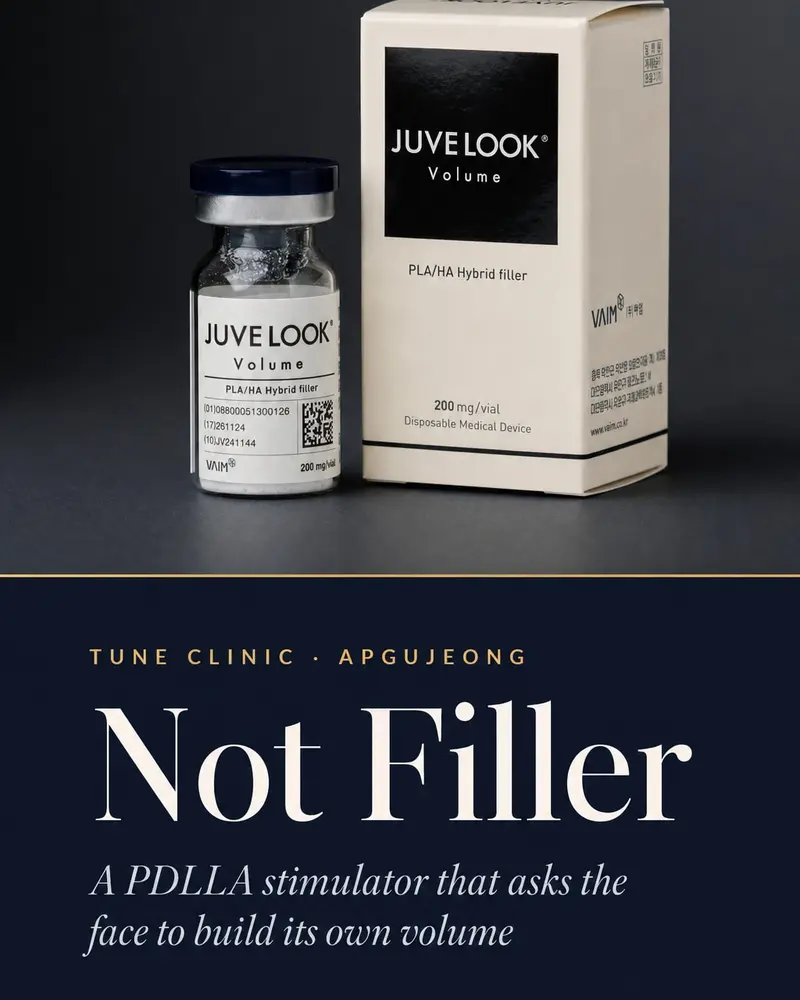
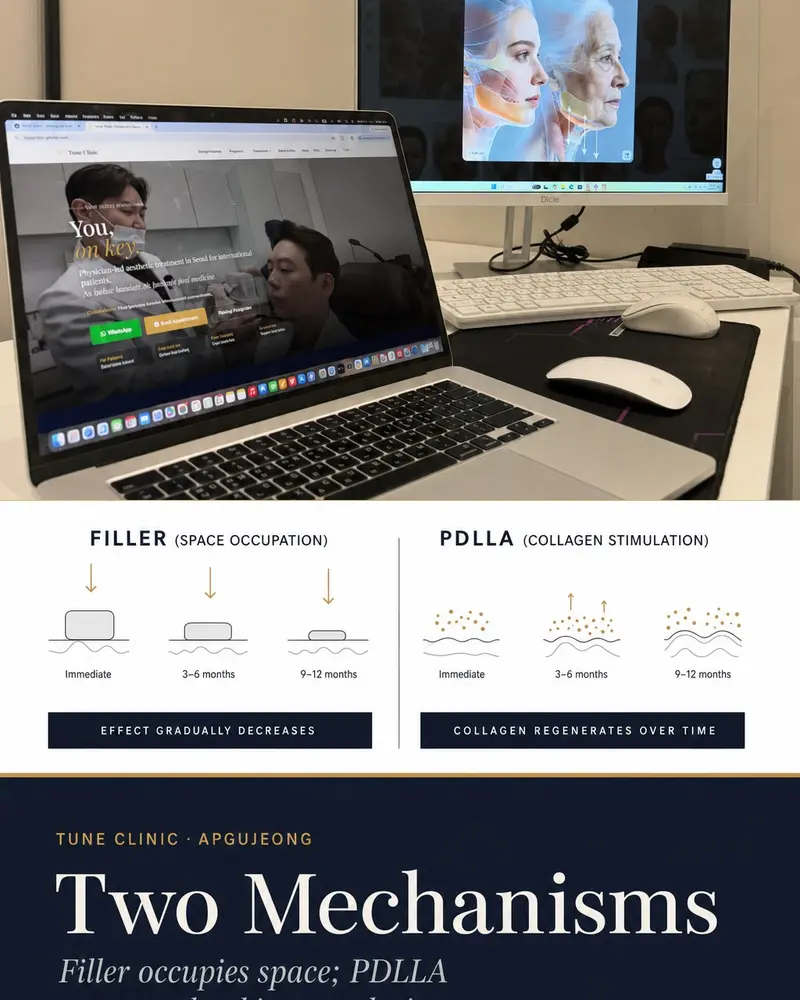
Juvelook Volume is not a filler. It is a PDLLA-based collagen stimulator — an injectable that does not occupy space itself but signals the skin to rebuild its own collagen scaffold over several weeks. Hyaluronic acid filler adds volume immediately by physically filling a space; Juvelook Volume adds volume gradually by prompting tissue the patient already has to do the work.
You have probably done this: zoomed into two before-and-after photos, trying to guess which one is filler and which one is something else, because the results look different in a way you can’t quite name. That difference is usually the mechanism, not the skill of the injector. One approach fills a void. The other rebuilds the structure around it.
What is PDLLA and how is it different from filler?
PDLLA (poly-D,L-lactic acid) is a biodegradable polymer that triggers a controlled inflammatory response in the dermis, prompting fibroblasts to lay down new collagen over time. It does not sit in the tissue as a static filling agent — it is broken down by the body as collagen production increases, so the volume you see later is largely the patient’s own tissue, not the product.
Filler, by contrast, is inert and volumetric from the moment it’s placed. That is precisely why filler correction is immediate and precisely why it does not improve the underlying skin quality — it changes shape, not structure. Patients whose main complaint is looseness or a hollow contour due to genuine collagen loss, rather than a single deficit that needs filling, are often better served by a stimulator.
What we watch for in consultation is not just where the volume is missing, but why. A face that has lost collagen density needs a different answer than a face with one localized hollow.
Where does Juvelook Volume get placed, and why does depth matter?
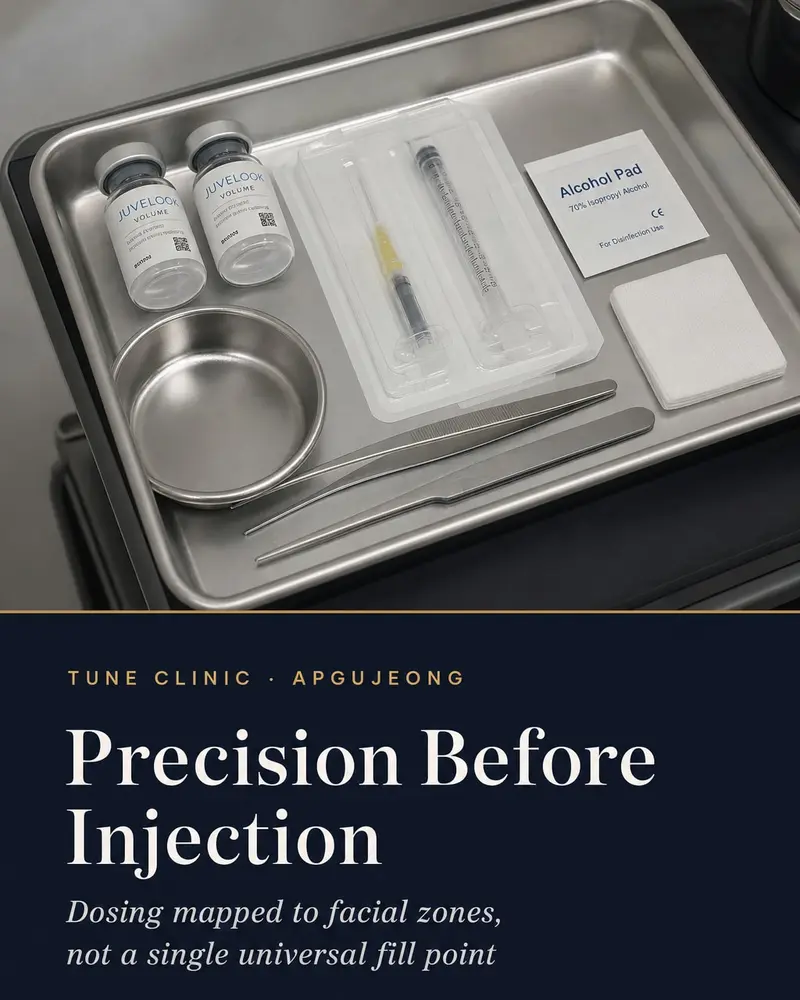
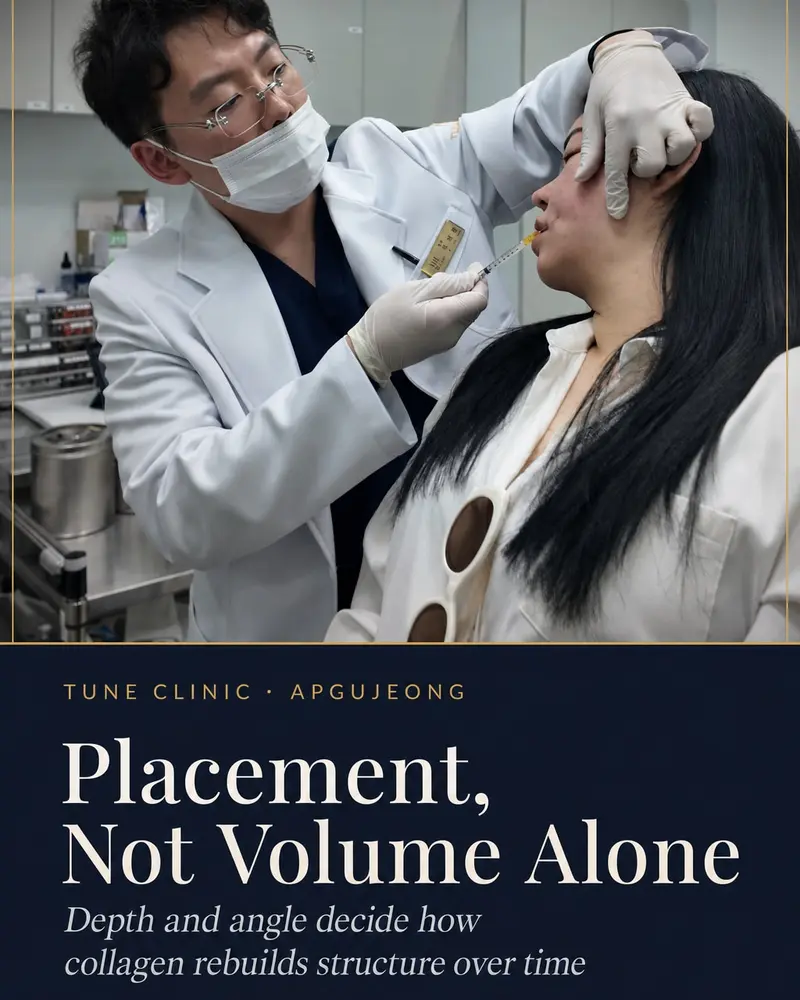
Juvelook Volume is placed at depths and doses specific to each facial zone — the mid-face, temple, and jawline do not receive the same plane or amount, because the tissue architecture in each is different. Injecting at the wrong depth can produce lumping, an uneven build, or a result that reads as “done” rather than restored.
In our clinic, mapping precedes injection. We assess:
- Where volume loss is structural (deep fat compartments, bone) versus superficial (skin thinning)
- Whether the ligaments supporting the area have laxity that a stimulator alone won’t correct
- Skin thickness and prior filler or thread history in the zone
This is the same judgment that governs any injectable decision at this clinic — the tool is chosen after the assessment, not before it. Sometimes the honest answer for a given zone is filler, or a combination, or nothing at all yet.
How long does it take to see results, and how long do they last?
Juvelook Volume results build gradually, typically becoming visible over four to eight weeks and continuing to develop over the following months as collagen synthesis progresses — there is no on-the-table volume the way filler provides. In most patients, a course involves more than one session spaced weeks apart, and the collagen response, once established, is typically reported to last longer than a single filler correction, though this varies by anatomy, age, and skin quality.
This is also the trade-off patients should weigh honestly. If you need to look different for an event next week, a collagen stimulator is the wrong tool — that is a job for filler, and we will say so plainly.
Downtime and what recovery actually looks like
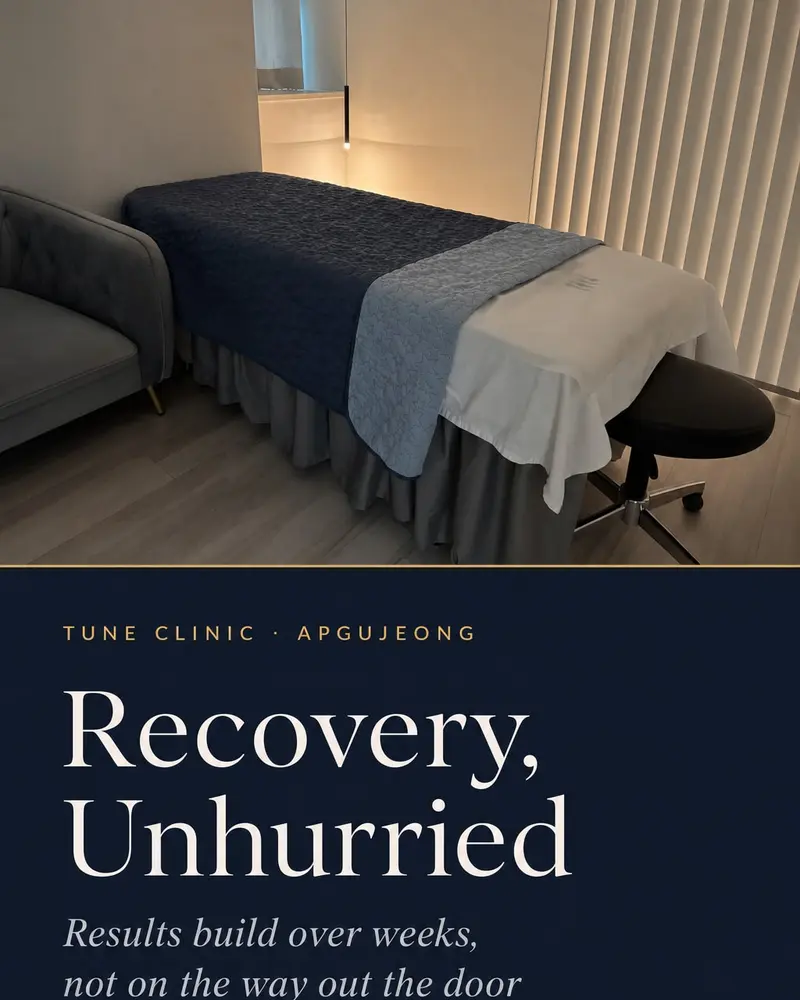
Swelling and mild tenderness at injection points are common for a few days; visible bruising is possible but usually resolves within a week. There is no dramatic “reveal” moment — the face looks like itself immediately after, with change accumulating quietly in the weeks that follow.
Who should not get Juvelook Volume?
Juvelook Volume is not appropriate for patients seeking an immediate, dramatic volume change, patients with active skin infection or inflammation in the treatment area, or those who are pregnant or breastfeeding. Patients with significant ligament laxity or bone resorption may need a structural approach — filler, threads, or in some cases a surgical consult — before a stimulator makes sense on its own.
Collagen stimulation also assumes a certain baseline of tissue health to respond to. In very thin or severely photodamaged skin, results can be slower and less predictable, which is a conversation we have before treatment, not after.
For patients whose main concern is skin laxity from deeper structural layers rather than volume alone, a lifting-focused approach such as Ultherapy may be the more relevant first step — see our signature lifting page for how we sequence that decision. For patients specifically asking about filler as an alternative or complement, our filler overview covers when that tool is the better fit.
FAQ
Is Juvelook Volume the same as Juvelook Skin?
No. Juvelook Volume is formulated and dosed for deeper structural support in areas like the mid-face and temple, while Juvelook Skin is a superficial formulation aimed at surface tone and texture. Both are PDLLA-based collagen stimulators, but they are placed at different depths for different goals.
Does Juvelook Volume replace filler entirely?
Not necessarily. Some patients need the immediate, precise correction filler provides for a single hollow; others need the gradual, broader rebuilding a stimulator offers. Many treatment plans in our clinic combine both, sequenced according to what the assessment shows rather than substituting one for the other by default.
How many sessions of Juvelook Volume are typically needed?
Most patients require more than one session, spaced several weeks apart, to build a visible collagen response. The exact number depends on baseline skin quality, the zone treated, and how the tissue responds after the first session, which is why we reassess between treatments rather than committing to a fixed protocol upfront.
Is Juvelook Volume painful?
Mild discomfort during injection is typical, similar to other injectable treatments, and topical or local anesthetic is generally used to manage it. Post-treatment swelling and tenderness are common for a few days, though most patients resume normal activity the same day.
Ready to plan your treatment?
Tune Clinic Apgujeong offers English-language consultations with Dr. Ju and Dr. Cha — a structured assessment, not a sales call.
→Book an appointmentto pick a time that fits your Seoul itinerary.
→Message us on WhatsAppto ask in English before you commit.