On this page



Botox errors are rarely caused by poor injection technique. They are caused by incomplete assessment before the first unit is drawn. When muscle depth, movement pattern, resting tension, and prior treatment history are not individually mapped, outcomes trend toward asymmetry, heaviness, or premature fade — problems that are difficult to correct once the toxin has been placed.
What Does a Physician Actually Evaluate Before Botox?
A structured pre-injection assessment covers four distinct variables. Each one independently influences where units are placed and how many are used.
1. Muscle mass and depth Facial muscles vary considerably in bulk between individuals and across the face of the same person. A heavily developed corrugator requires a meaningfully different dose than an atrophic one. Estimating this by observation alone is unreliable; experienced physicians palpate and observe dynamic contraction to form a working picture of true muscle volume.
2. Movement pattern Some patients recruit the frontalis symmetrically; many do not. One side may activate earlier, contract more forcefully, or compensate for a contralateral weakness. Injecting to a symmetry template — placing equal units at mirrored points — does not account for asymmetric recruitment and often produces asymmetric results.
3. Resting tension A muscle under chronic resting tension behaves differently from one that is relaxed at baseline. Elevated resting tone in the glabella, for example, affects how rapidly the toxin is metabolised and how visible the response appears in the weeks that follow.
4. Prior treatment history Repeated neuromodulator treatment alters baseline muscle tone over time. A patient with several years of consistent Botox may require recalibration rather than a repeat of their previous protocol. Scar tissue, filler previously placed in the same zone, and any history of thread placement can also influence diffusion and the appropriate depth of injection.
Why Injection Points Are Mapped to Vectors, Not Templates
Standard anatomical diagrams show average muscle positions. They are useful teaching tools; they are not patient-specific maps.
The direction in which a muscle contracts — its vector — determines where along its length a neuromodulator will achieve the most precise functional effect. Placing a unit two millimetres lateral to the optimal point on the frontalis can shift brow position in an unintended direction. On the crow’s feet, the same logic applies: the lateral orbicularis oculi fans outward at angles that differ between patients, and a point that works well for one person may over-relax or under-treat another.
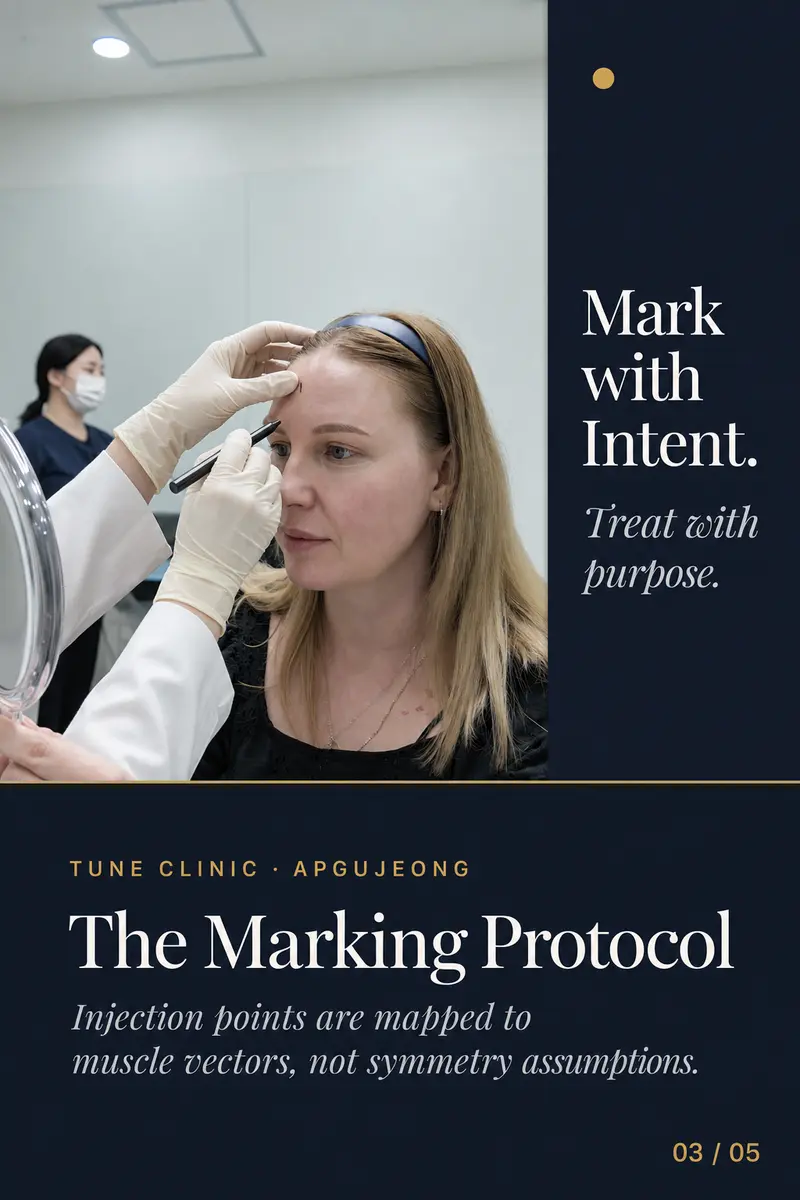
The marking step is not a formality. It is where the physician translates their dynamic assessment into a spatial plan — a translation that cannot be done well in under two minutes.
At Tune Clinic, injection points are identified after dynamic assessment in multiple planes of movement: smiling, squinting, raising, and at rest. The marks made on the skin reflect observed vectors, not assumed ones.
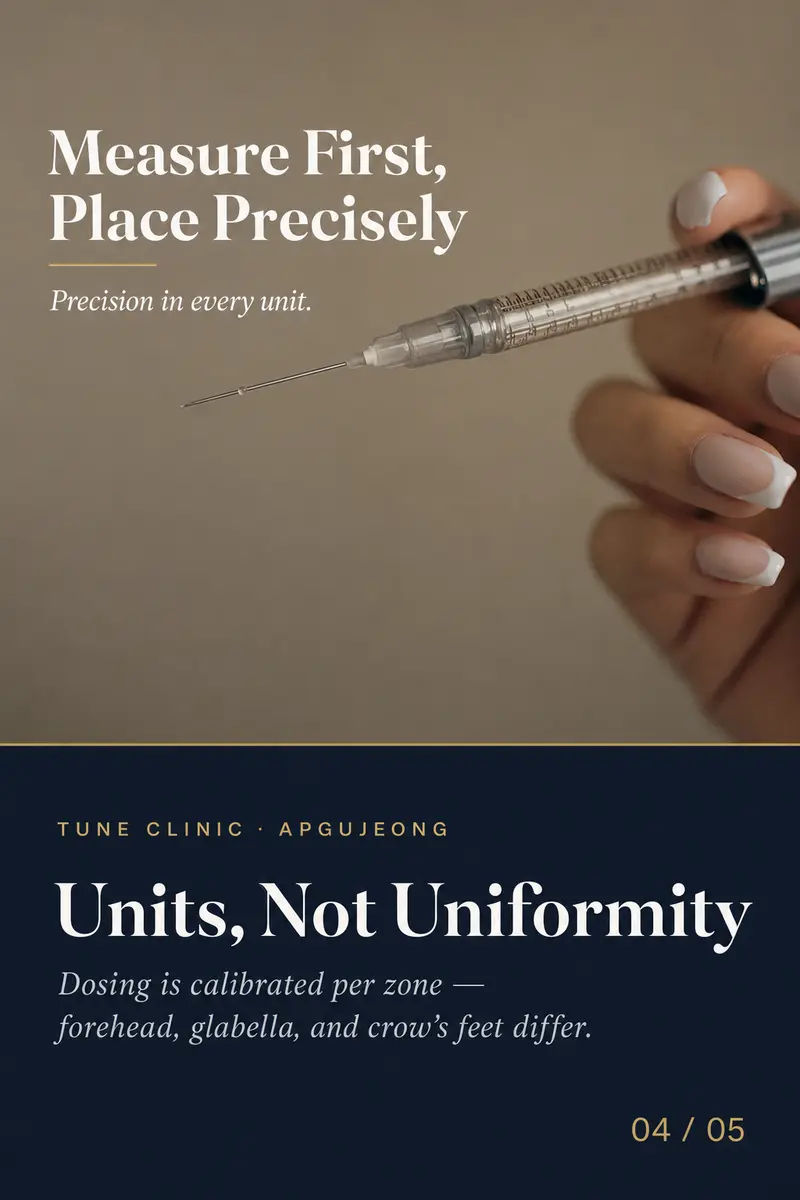
Does Zone Matter for Dosing — Forehead, Glabella, Crow’s Feet?
Yes, and the differences are clinically significant.
The forehead carries the frontalis, the only brow elevator. Under-dosing leaves movement unaddressed; over-dosing drops the brow. The margin between these outcomes is narrow and is determined largely by the patient’s brow position at baseline and the degree of frontalis dependence for upper-lid elevation. Patients with mild ptosis or heavy brow tissue require conservative dosing here regardless of their cosmetic goals.
The glabella — the corrugator and procerus complex — generally tolerates and often requires higher unit counts relative to its surface area because the muscles involved are comparatively thick and are frequently under chronic tension. This is the zone where under-treatment is most often reported when dosing is applied uniformly across the upper face.
The crow’s feet demand precision over volume. The orbicularis here is superficial and the tissue thin. Diffusion into the neighbouring zygomaticus or the lower orbicularis can alter smile dynamics in ways patients find more distressing than the original lines.
A note on the lower face
Masseter, mentalis, and platysmal dosing each introduce additional risk variables. The lower face is not a routine add-on. It requires its own assessment and should be approached with a distinct clinical logic from upper-face treatment. For patients whose primary concern involves volume loss or structural support rather than dynamic movement, filler may address what neuromodulator cannot.
How Physician-Led Assessment Changes the Outcome
The practical difference between a physician-led consultation and a protocol-driven appointment is the quality of the information that enters the dosing decision.
A protocol tells a practitioner to place a fixed number of units at fixed coordinates. A physician-led assessment tells the physician how this patient’s muscles move, how deep they sit, what resting state they carry, and what history they bring into the room. The injection itself may take minutes; the assessment that makes it accurate takes longer and cannot be compressed without consequence.
This is the principle behind Tune Clinic’s design method: that treatment planning precedes treatment delivery, and that the two are never reversed.
FAQ
How many units of Botox does the average person need?
There is no clinically useful average. Unit requirements depend on muscle mass, resting tension, the specific zones being treated, and the degree of movement reduction the patient wants. Published ranges exist as rough reference points, but experienced physicians calibrate from direct assessment rather than from a standard dose. Applying an average to an individual patient is one of the most common sources of unsatisfying results.
Why does Botox sometimes look uneven after treatment?
Uneven results most often trace back to asymmetric muscle recruitment that was not accounted for during assessment, rather than imprecise injection placement. When equal units are placed at mirrored points on a face that does not move symmetrically, the outcome will reflect the underlying asymmetry — sometimes more visibly than before treatment. A dynamic assessment before injecting is the primary way to anticipate and correct for this.
How long does Botox last and why does it fade faster for some people?
Duration varies between individuals and is influenced by muscle mass, metabolic rate, physical activity level, and the cumulative history of prior treatment. Patients with larger, more active muscles tend to metabolise the toxin more quickly. Resting muscle tension also plays a role. Most patients find results in high-activity zones — such as the glabella in patients who frequently contract those muscles — last a shorter time than results in lower-activity areas.
Is Botox safe to combine with filler in the same session?
In most cases, yes. Many patients benefit from addressing both dynamic movement and volume in the same visit. The clinical consideration is sequencing and zone overlap: injecting a neuromodulator into tissue recently filled in the same region can, in some circumstances, affect diffusion patterns. A physician assessing both treatments together can plan the session to avoid these interactions rather than treating them as independent procedures.
What is the difference between a consultation and a pre-treatment assessment?
A consultation is a conversation about goals, history, and options. A pre-treatment assessment is a clinical examination — dynamic observation of muscle recruitment, palpation of tissue, review of prior treatment records — that informs the specific dosing and placement decisions. Both should happen before any unit is placed. When they are compressed into the same two minutes, one of them is not being done adequately.
Ready to plan your treatment?
Tune Clinic Apgujeong offers English-language consultations with Dr. Ju and Dr. Cha — a structured assessment, not a sales call.
→Book an appointmentto pick a time that fits your Seoul itinerary.
→Message us on WhatsAppto ask in English before you commit.