On this page
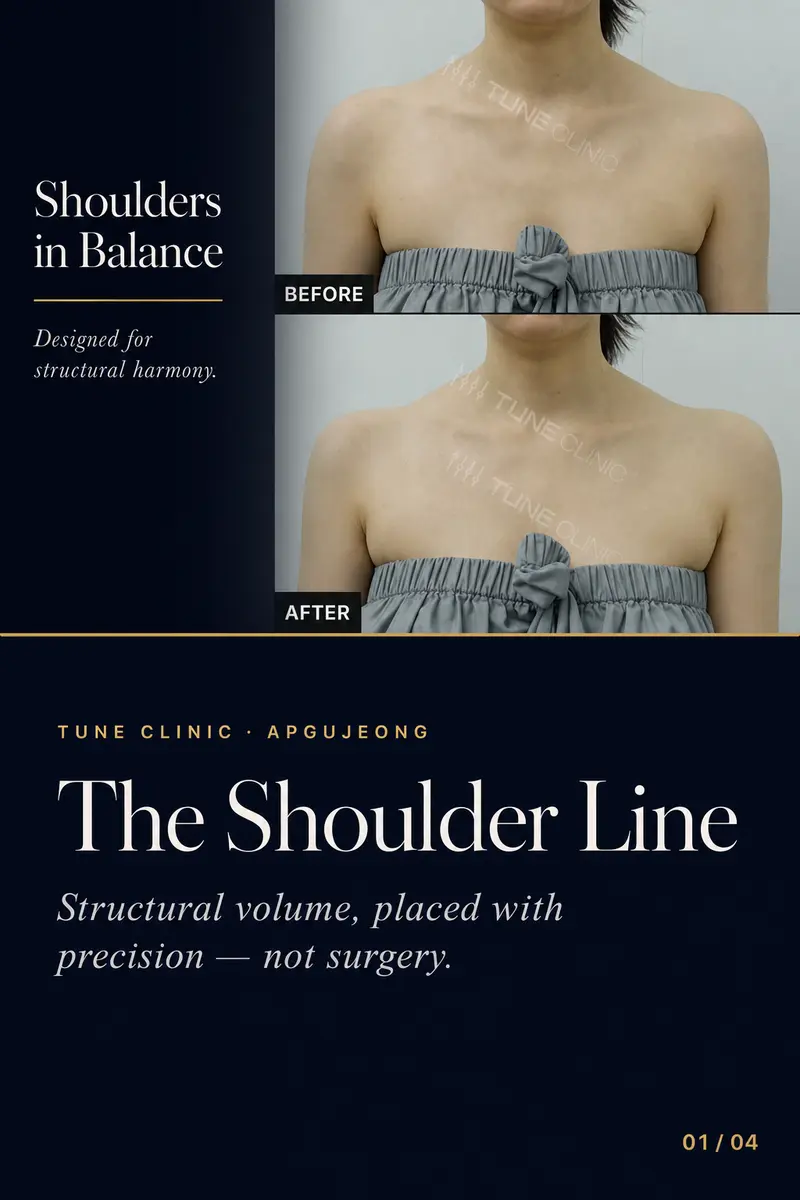


Shoulder and hip contouring with dermal filler is a legitimate structural procedure — but the margin for error is wider than in facial work, and the consequences of poor placement are correspondingly harder to reverse. Correct outcomes depend on three things working together: a physician-drawn volume map before any product is loaded, instruments sized for body tissue rather than facial tissue, and placement at the correct anatomical depth. When any of those three elements is missing, the result is bulk rather than contour — volume that sits superficially and reads as swelling rather than shape.
Why Body Filler Is Not Facial Filler Scaled Up
The tissues of the shoulder and lateral hip are structurally different from facial soft tissue. Skin thickness, subcutaneous fat architecture, fascial layers, and the mechanical forces that act on those areas daily all differ substantially from the midface or temple. Filler products approved for body use are typically higher-viscosity, higher-cohesivity formulations — designed to resist the compressive and shear forces that body sites generate with movement.
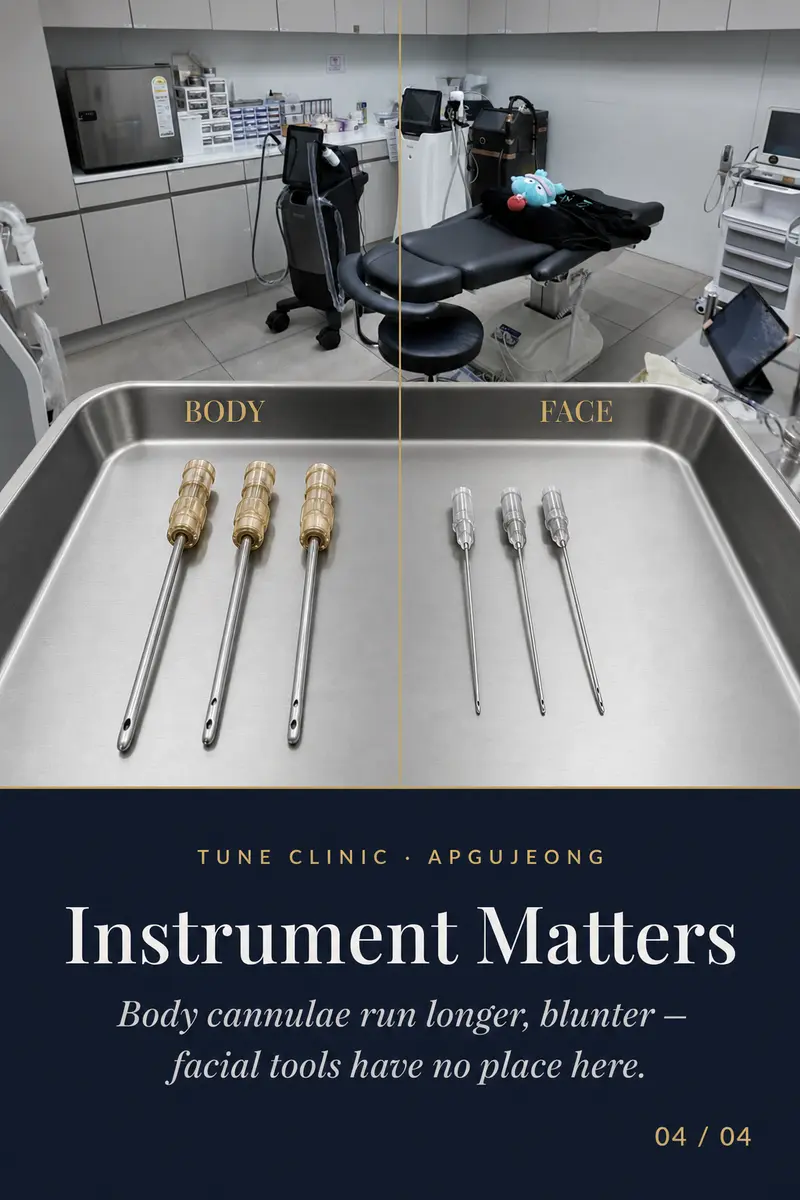
Beyond product selection, instrument choice matters in a way that is rarely communicated clearly. Body cannulae are longer and have a blunter, larger-gauge tip profile than the cannulae used for facial work. This is not an arbitrary distinction. A facial cannula introduced into deep body tissue cannot reliably deposit product at the correct plane — it is too short to reach the target depth consistently, and the resistance it encounters when passing through denser body tissue increases the risk of off-plane placement. The result is filler that sits too superficially, produces visible or palpable irregularity, and does not create the clean silhouette transition the patient sought.
The instrument is part of the technique. A physician who uses facial tools for body work is not simply improvising — they are operating outside the conditions the technique was designed for.
What Does Anatomical Mapping Actually Mean?
Mapping, in the context of shoulder and hip contouring, means that the physician marks the target anatomy on the patient’s skin before any injection begins — with the patient standing, in the position where gravity acts on the tissue as it will in daily life. This is not a formality. Standing assessment changes the apparent location of volume deficits relative to lying-down assessment, and filler placed without accounting for gravitational load will sit differently once the patient is upright.
A volume plan documents:
- Total volume per zone — shoulder cap versus posterior shoulder line versus lateral hip require different volumes, and over-filling a single zone while under-filling an adjacent one creates a step rather than a gradient.
- Target depth per zone — suprafascial versus subfascial placement produces different surface projections; depth is not interchangeable between sites.
- Symmetry reference points — body contouring is bilateral work, and small volumetric asymmetries become visible at scale.
Without a documented plan, correction during the session depends entirely on real-time visual judgment, which is harder to reproduce across sessions and harder to communicate to a different physician if follow-up is required.
How Much Product Is Typically Required?
Body sites consume meaningfully more product than facial sites, and patients who are accustomed to facial filler volumes are often surprised by this. The lateral hip requires sufficient volume to produce projection across a surface area that may span ten or more centimetres; the shoulder cap requires enough structural mass to change a silhouette visible in clothing. Small volumes placed without a map tend to be absorbed into the surrounding tissue without producing a readable contour change.
That said, over-filling in a single session is its own risk. Swelling from a large-volume body procedure can temporarily obscure the true result, making accurate same-session assessment difficult. Staged treatment — placing a calibrated initial volume, allowing resolution, then assessing whether additional volume is warranted — is a more controlled approach than attempting to achieve the full result in one visit.
What Happens If Placement Is Incorrect?
Superficially placed body filler can produce visible contour irregularity, a lumpy surface texture, or a broad convexity rather than a defined projection. Depending on the product used, enzymatic dissolution with hyaluronidase is possible for hyaluronic acid-based fillers, but this is easier to say than to execute cleanly in a large body area. Prevention — meaning correct depth from the start — is substantially simpler than correction.
For patients researching filler placement principles more broadly, the approach to volume planning and physician-led assessment described here shares the same underlying logic as our facial filler protocol.
Is Body Contouring Filler the Right Choice for You?
Body filler for the shoulders and hips is appropriate for patients with a defined structural contour goal — most commonly softening the visual transition at the lateral hip or adding projection to the shoulder cap — in whom the volume deficit is moderate and the overlying tissue quality is adequate to support the product. It is not a weight-loss tool, it does not address skin laxity, and it does not replace the structural role of muscle in athletes whose shoulder definition is primarily muscular in origin.
Patients with substantial overlying soft tissue, significant skin laxity, or expectations that exceed what volume alone can achieve may be better served by a different approach or by a candid conversation about realistic goals. That conversation — conducted in English, with physician-level assessment — is the appropriate starting point, not the procedure itself.
For patients where the primary concern is skin laxity rather than volume, the Tune Clinic design method outlines how physician assessment determines which modality — or combination — addresses the underlying structural issue rather than working around it.
FAQ
How long does shoulder and hip filler last?
Longevity depends on the specific product used, the depth of placement, and the mechanical load on the treated area. Body sites are subject to more movement and compression than most facial sites, which can accelerate product integration and gradual resorption. In clinical experience, body-placed high-viscosity hyaluronic acid fillers typically remain visible for a comparable duration to facial filler at depth, though individual variation is significant. A physician can give a more precise expectation based on the specific product selected for your anatomy.
Can hip dip filler migrate or move after treatment?
Migration is a real risk when product is placed at an incorrect depth or when a product with insufficient cohesivity is used in a high-movement area. Superficial placement is the most common cause of visible migration in body contouring. Body-grade filler placed at the correct subfascial or suprafascial depth by an experienced physician, using appropriate instruments, has a substantially lower migration risk than product deposited too shallowly with facial-grade tools.
Is shoulder filler safe?
Shoulder filler is considered safe when performed by a physician with specific training in body anatomy, using body-appropriate products and cannulae, with pre-treatment vascular assessment. As with any injectable procedure, the risks — including vascular occlusion, infection, product displacement, and asymmetry — are real, and their management requires medical training. Physician-led treatment with a documented volume plan and appropriate instruments is the standard of care.
How many sessions are needed for visible hip contouring results?
Many patients see a meaningful contour change after a single well-planned session, though the precise volume required depends on the degree of deficit and the patient’s anatomy. A staged approach — assessing the initial result after swelling resolves before adding further volume — typically produces more accurate final outcomes than attempting to reach the full target volume in one visit. Your physician will estimate the likely number of sessions after an in-person standing assessment.
Does body contouring filler hurt more than facial filler?
Body contouring procedures involve larger volumes and longer cannula passes than most facial treatments, which can increase procedural discomfort. Topical anaesthetic, local anaesthetic blocks, or product mixed with lidocaine are all used depending on the site and the patient’s preference. Most patients describe the experience as manageable with appropriate preparation; a physician consultation is the right place to discuss anaesthetic options for your specific treatment plan.
Ready to plan your treatment?
Tune Clinic Apgujeong offers English-language consultations with Dr. Ju and Dr. Cha — a structured assessment, not a sales call.
→Book an appointmentto pick a time that fits your Seoul itinerary.
→Message us on WhatsAppto ask in English before you commit.