On this page

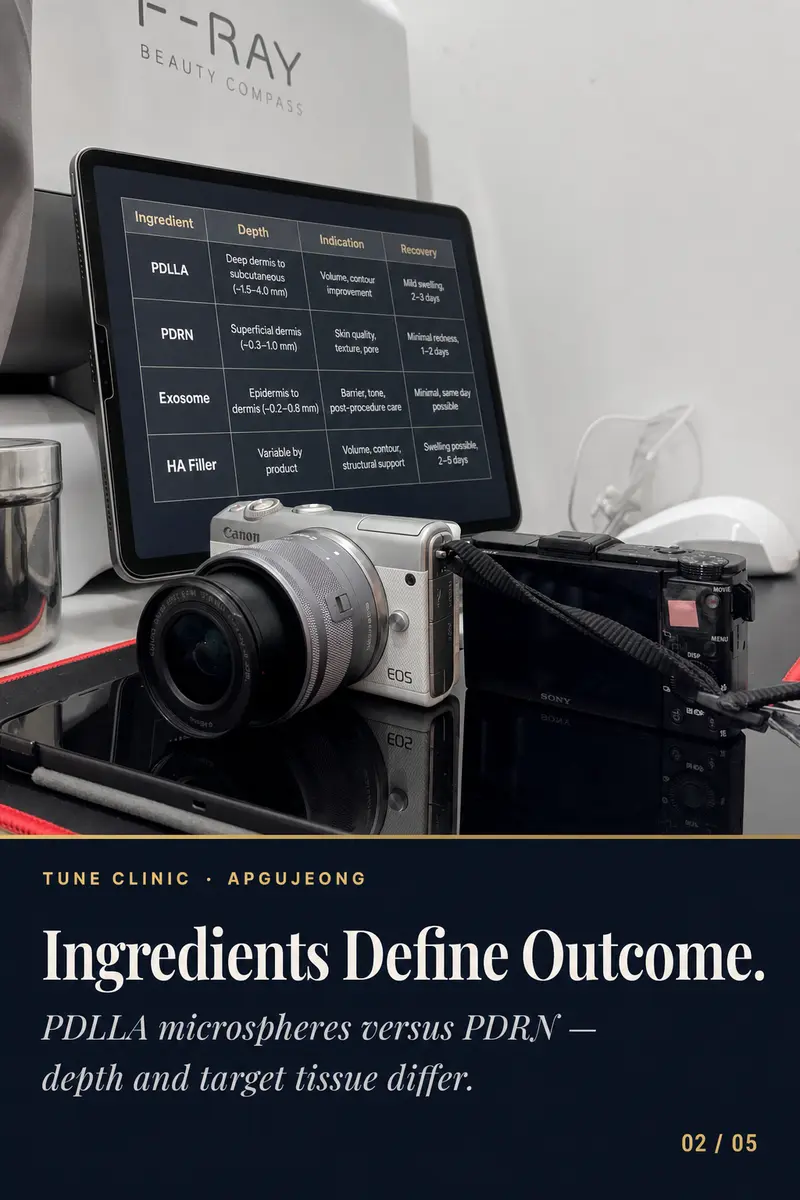

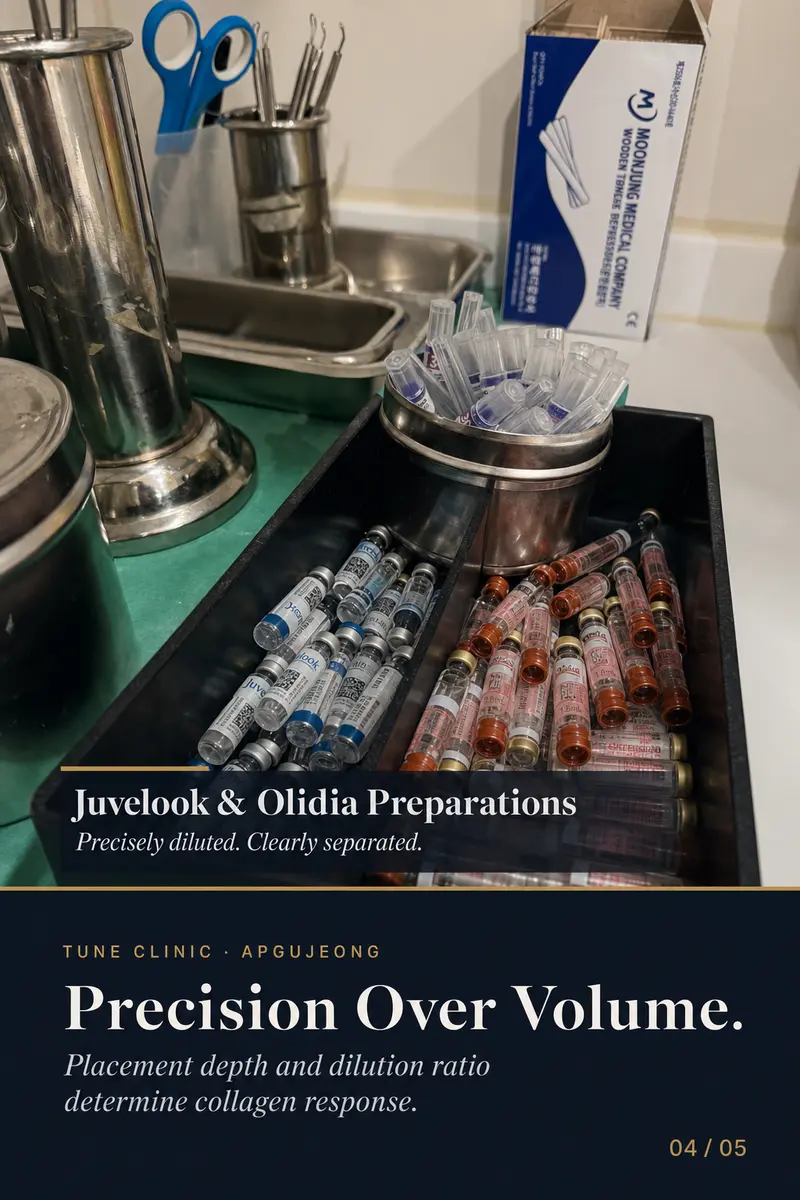

Juvelook and Olidia are both collagen-stimulating injectables, but they work through distinct mechanisms, target different tissue layers, and suit different indications — they are not interchangeable, and selecting the wrong one for a given concern extends recovery without improving outcome.
How Do Juvelook and Olidia Actually Work?
The distinction begins at the ingredient level.
Juvelook (available in Volume and Skin formulations) is built on PDLLA — poly-D,L-lactic acid microspheres suspended in PDRN. The PDLLA component acts as a long-cycle biostimulator: microspheres are gradually absorbed over months, triggering a fibroblast response and new collagen synthesis in the deeper dermis and subdermis. The PDRN component provides concurrent tissue repair and hydration signalling at a shallower level. The combined profile means Juvelook is addressing both structural volume deficit and surface quality within a single product — though the two timelines are distinct.
Olidia is a PDLLA-based stimulator formulated without a PDRN carrier. Its mechanism centres on controlled microparticle absorption and the resulting collagen cascade in the mid-to-deep dermis. Because its action is more narrowly focused on structural stimulation, placement depth, dilution, and injection technique determine most of the clinical outcome.
The question I ask in a consultation is not which product is newer or more popular — it is which tissue problem we are actually solving. PDLLA and PDRN act on different cellular targets. Selecting by indication rather than by trend produces more consistent results.
What Tissue Depth and Indication Separate Them?
Neither product belongs in every consultation, and the decision framework usually follows three axes:
1. Laxity versus texture Significant skin laxity — particularly in the mid-face, jawline, or neck — generally benefits from deeper structural stimulation. When the primary concern is dermal thinning, dullness, or fine surface lines without meaningful volume loss, a product with stronger superficial PDRN signalling (such as Juvelook Skin) addresses the tissue layer where the problem actually sits.
2. Volume deficit For patients with measurable soft-tissue volume loss, Juvelook Volume’s PDLLA load at subdermis depth offers a meaningful scaffold response. Attempting to correct structural volume with a product dosed for superficial dermal work produces underwhelming results and often more sessions than necessary.
3. Recovery window Both products carry a post-injection period during which swelling, papule formation at injection sites, and temporary irregularity can occur. The duration and character of this period differ based on dilution ratio, placement depth, and the individual patient’s tissue response. A physician who understands both products can calibrate the protocol against a patient’s real-world schedule rather than a fixed product insert.
What about combining them?
In some patients, combining stimulators across sessions — or occasionally within a session at different depths — is clinically reasonable. This is not a default recommendation; it requires a clear rationale tied to the specific laxity grade, tissue quality, and the patient’s prior treatment history. The decision should be physician-led, not menu-driven.
Why Placement Technique Determines the Result
With biostimulators, the product is only part of the equation. Dilution ratio, injection plane, and distribution pattern all affect the collagen response and the side-effect profile. Underdiluted PDLLA placed too superficially increases the risk of visible or palpable nodules. Overdiluted product placed too deep reduces stimulation efficiency.
This is where physician judgment — rather than a standardised clinic protocol — carries the most weight. Assessing tissue thickness, laxity grade, and the presence of prior filler or stimulator deposits before placing anything determines whether the session produces a meaningful result or simply adds material to a poorly mapped anatomy. For more on how this assessment informs treatment planning at Tune Clinic, see our design method.
Patients who have had previous biostimulator treatments at other clinics may also arrive with residual PDLLA that has not fully resorbed. A physician needs to account for that baseline before adding another stimulation cycle.
Is One Product Better Than the Other?
Neither Juvelook nor Olidia is categorically superior — the concept of a universally “better” collagen stimulator is a marketing frame, not a clinical one. Each product performs well when matched to the right indication and placed with appropriate technique. Each performs poorly when used as a catch-all solution for any concern involving the words “collagen” or “skin quality.”
For patients researching these products independently, the most useful insight is this: the product brochure describes what a stimulator can do in ideal conditions. A physician consultation describes what it will likely do for your specific anatomy, laxity grade, and recovery capacity. Those are different documents.
If lifting or tightening is a concurrent goal, it is also worth understanding where energy-based devices such as Ultherapy Prime or Thermage FLX sit alongside biostimulators in a sequenced plan — they work at different tissue depths and can complement rather than duplicate injectable collagen stimulation.
FAQ
What is the difference between Juvelook and Olidia?
Juvelook contains PDLLA microspheres combined with PDRN, giving it a dual mechanism that addresses both structural collagen stimulation and superficial tissue repair. Olidia is a PDLLA-based stimulator without PDRN, with its primary effect concentrated on mid-to-deep dermal collagen remodelling. The right choice depends on the indication — laxity, volume loss, or skin quality — rather than on which product is newer or more frequently discussed.
Which is better for skin laxity — Juvelook or Olidia?
For meaningful skin laxity, the key factor is whether the concern is primarily structural (volume and support loss) or surface-level (thinning and quality). Deeper structural laxity typically warrants a protocol with stronger subdermis stimulation, while superficial quality concerns respond better to shallower PDRN-mediated repair. A physician assessment of your laxity grade and tissue quality is necessary before a product recommendation makes clinical sense.
How many sessions of Juvelook or Olidia do I need?
Session number depends on baseline tissue condition, the degree of volume loss or laxity, and how the patient responds to an initial treatment cycle. Small studies and clinical experience suggest that most patients require a series of sessions spaced several weeks apart, followed by maintenance intervals. A single session rarely produces the full collagen response, as PDLLA stimulation operates on a months-long timeline.
Is there downtime after Juvelook or Olidia treatment?
Both products can cause temporary swelling, redness, and small papules at injection sites in the days following treatment. The character and duration of this period vary by product, dilution ratio, depth of placement, and individual skin response. Patients with limited recovery windows should discuss scheduling with their physician before committing to a protocol, as technique adjustments can influence the post-procedure course.
Can Juvelook and Olidia be used together?
Combining stimulators is clinically possible and sometimes appropriate, but it is not a standard default recommendation. A rationale based on your specific anatomy, prior treatment history, and the tissue layers being targeted is required before combination protocols make sense. This decision belongs in a physician consultation, not a product comparison.
Ready to plan your treatment?
Tune Clinic Apgujeong offers English-language consultations with Dr. Ju and Dr. Cha — a structured assessment, not a sales call.
→Book an appointmentto pick a time that fits your Seoul itinerary.
→Message us on WhatsAppto ask in English before you commit.