On this page



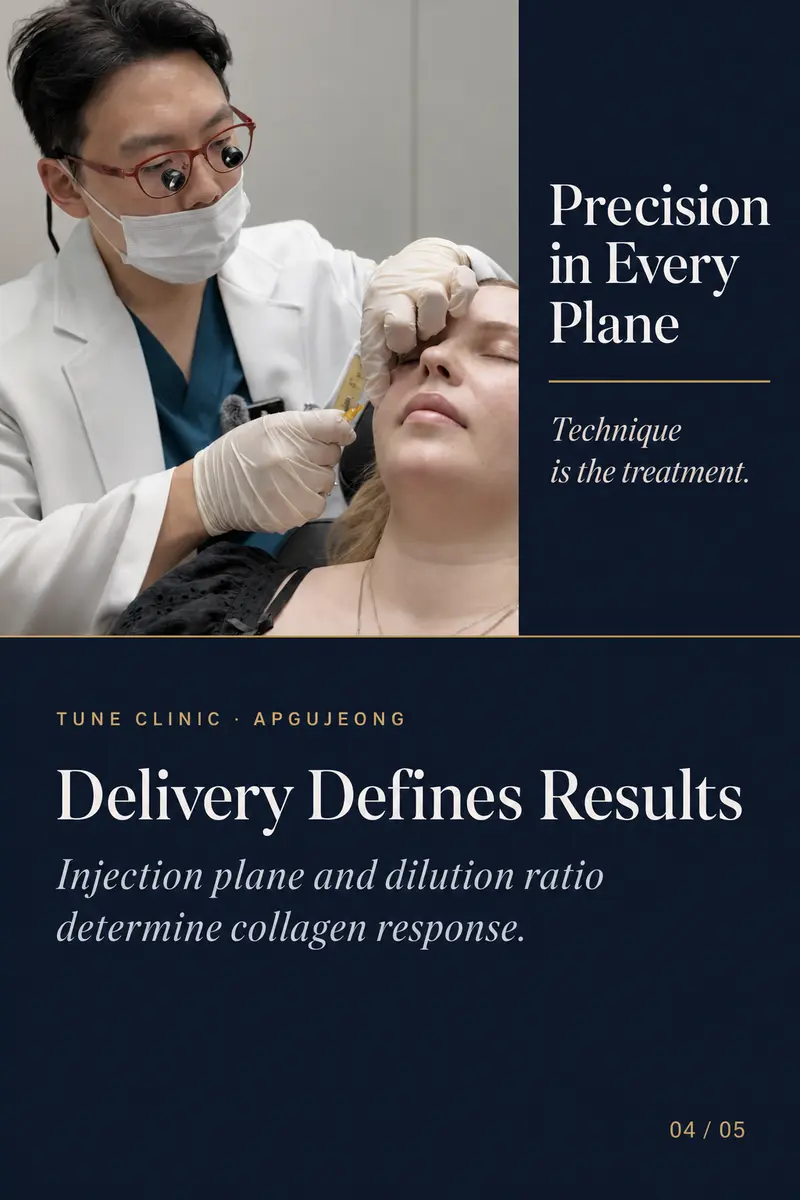

Juvelook is a biostimulator, not a traditional hyaluronic acid filler. Its dual PDLLA-HA formulation works by triggering the body’s own collagen synthesis rather than physically displacing tissue to create volume — which means the clinical planning, injection technique, and patient expectations that apply to conventional filler do not apply here.
What Is Juvelook and How Does It Work?
Juvelook contains two active components: poly-D-L-lactic acid (PDLLA) microspheres and a low-molecular-weight hyaluronic acid carrier. The HA provides immediate superficial hydration and acts as the delivery medium. The PDLLA is the primary therapeutic agent — once deposited in the dermis or subdermis, the microspheres degrade gradually, stimulating fibroblast activity and prompting the laying down of new collagen.
This is categorically different from a volumising filler such as Juvederm or Belotero, where the injected HA gel physically occupies space to lift or plump. With Juvelook, the visible improvement emerges over weeks to months as the tissue itself remodels. The product does not sit in the face; it instructs the face to rebuild.
Juvelook Volume and Juvelook Skin differ in PDLLA concentration and target depth, which is why the two formulations serve different tissue needs. Volume is indicated for deeper structural support, Skin for superficial quality improvement — texture, fine lines, radiance.
Why Does Injection Plane Matter More Than Dose?
With volumising HA fillers, the bolus size and placement depth determine the lift. With Juvelook, those variables determine whether collagen induction actually occurs.
PDLLA microspheres must reach the correct tissue plane to contact fibroblasts. Too superficial and the product risks visibility or irregular nodule formation; too deep and the stimulus does not reach the dermal architecture where remodelling is most needed. Dilution ratio also affects the distribution and degradation profile of the microspheres — a more dilute preparation spreads further through the tissue, which is appropriate for diffuse skin quality work but less so for focal structural support.
The question we ask before any Juvelook session is not ‘how much product?’ but ‘what depth, what dilution, and what interval will produce organised collagen rather than a fibrotic response.’ Those three variables are set per patient, not per protocol sheet.
Session spacing is a third variable that tends to be underweighted. Because the collagen response takes time, stacking sessions too quickly risks overstimulating the tissue before the previous cycle has matured. In clinical practice, intervals are typically calibrated around the patient’s observed tissue response rather than fixed calendar dates.
Is Juvelook a Replacement for Filler?
Not always — and the distinction matters. A patient with significant volume loss driven by fat compartment atrophy or bone resorption will not see that deficit corrected by collagen induction alone. Biostimulators improve tissue quality, density, and fine-line texture; they do not restore lost structural projection in the way that a deeper-plane filler or Sculptra programme might.
For some patients, Juvelook is the primary intervention. For others — particularly those in their forties and beyond who present with both quality decline and structural loss — it functions best as part of a layered programme alongside other modalities. The physician’s role is to assess which element of change the patient is actually experiencing and to select the tool accordingly.
Patients who arrive requesting Juvelook specifically because they have read that it is ‘natural’ or ‘not a filler’ sometimes carry the assumption that more sessions always mean more improvement. That is not how biostimulators behave. Over-treatment can produce a firm, irregular texture rather than the soft, progressive improvement the protocol is designed to deliver.
Juvelook Within a Broader Skin Programme
Juvelook pairs well with energy-based devices that independently stimulate fibroblasts — selective RF microneedling, monopolar radiofrequency such as Oligio, or lifting modalities like Ultherapy Prime — because they act on overlapping but distinct aspects of the collagen-remodelling cycle. Sequencing matters: the tissue needs adequate recovery between sessions that each place a stimulus on the dermis. A physician-led programme maps these intervals rather than combining treatments ad hoc. For more on how Tune Clinic structures multi-modality planning, see our design method.
What Should Patients Expect From a Juvelook Programme?
Immediate post-injection appearance does not reflect the final result. There may be mild swelling or whealing at the injection sites in the first 24–48 hours, which resolves as the HA carrier disperses. The PDLLA scaffold then works over the following weeks.
Most patients notice a change in skin quality — density, hydration, fine-line softening — before they notice any structural effect. The timeline varies with age, baseline collagen density, and lifestyle factors such as UV exposure and sleep. Small studies suggest meaningful improvement across a structured course, but individual response is not linear and a single session should not be evaluated as though it were the complete treatment.
For patients considering Juvelook as part of a filler or skin quality programme, a useful starting point is understanding how Tune Clinic approaches injectable planning: Volume Chamaka-se outlines the framework for filler and biostimulator decisions together.
FAQ
Is Juvelook the same as a hyaluronic acid filler?
No. While Juvelook contains hyaluronic acid as a carrier, its primary mechanism is collagen induction via PDLLA microspheres rather than volume replacement. The HA disperses relatively quickly; the lasting effect comes from new collagen laid down by fibroblasts in response to the PDLLA scaffold.
How many Juvelook sessions are needed to see results?
The number of sessions depends on the patient’s baseline skin condition, age, and treatment goals. In clinical practice, a structured programme typically involves multiple sessions spaced to allow each collagen cycle to mature before the next stimulus is applied — rather than a fixed number applied uniformly to all patients.
Can Juvelook be combined with other injectables or devices?
Yes, but sequencing requires physician oversight. Juvelook can complement energy-based treatments and other injectables when the intervals are planned to avoid overlapping inflammatory burdens on the tissue. Combining treatments without a coordinated plan increases the risk of irregular texture or inadequate response.
What is the difference between Juvelook Volume and Juvelook Skin?
Juvelook Volume contains a higher PDLLA concentration and is indicated for deeper placement to address structural and volumetric decline. Juvelook Skin is formulated for more superficial work targeting skin quality — texture, fine lines, and overall radiance. A physician assessment determines which formulation, or combination, is appropriate.
Will Juvelook add visible fullness immediately after treatment?
There may be mild transient swelling from the HA carrier immediately after injection, but this is not the intended result and resolves within a day or two. The meaningful improvement develops gradually over weeks as collagen remodelling progresses — patients who expect immediate volumising results are working from the wrong frame of reference for this product.
Ready to plan your treatment?
Tune Clinic Apgujeong offers English-language consultations with Dr. Ju and Dr. Cha — a structured assessment, not a sales call.
→Book an appointmentto pick a time that fits your Seoul itinerary.
→Message us on WhatsAppto ask in English before you commit.