On this page

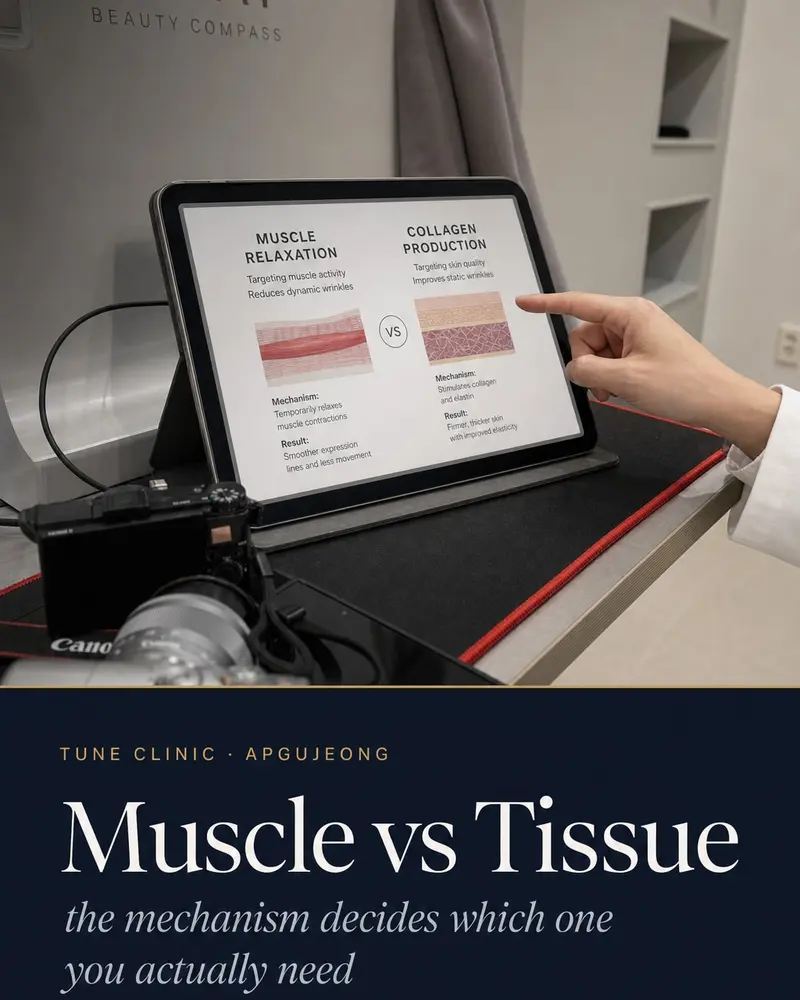



Botox and collagen stimulators are not interchangeable wrinkle treatments — Botox is a neuromodulator that relaxes the muscle causing a line, while a collagen stimulator such as Juvelook or Sculptra rebuilds tissue volume that has thinned over time. One addresses movement. The other addresses loss. Using the wrong one on the right line is why so many faces look either frozen or hollow.
You have probably had this exact moment: a line between your brows shows up in every photo, so you assume it needs “filling,” or a client at the front desk mentions a stimulator and you wonder if it also stops the crease from forming. The confusion is reasonable — both are injectables, both are marketed as anti-aging, and both get lumped into the same conversation.
What is the actual difference between Botox and a collagen stimulator?
Botox is a neuromodulator — it blocks the nerve signal that tells a muscle to contract, so the muscle stops moving as forcefully and the skin above it stops folding. A collagen stimulator does something structurally different: it triggers the body’s own fibroblasts to lay down new collagen over weeks to months, adding density and support to tissue that has lost volume or elasticity.
The mechanism gap explains almost everything else:
- Botox — targets muscle activity, works in days, needs repeating roughly every three to four months as the muscle regains movement.
- Collagen stimulators — target tissue quality, work gradually over one to three months per session, and are typically done in a short series spaced weeks apart, with effects building over the following months.
Neither one substitutes for the other because they are not solving the same problem at the anatomical level.
What solves what — expression lines vs volume loss?
Expression lines, the folds that appear only when you frown, squint, or raise your brows, are caused by repeated muscle contraction — this is what Botox is built for. Volume loss — a hollow cheek, a thinning temple, crepey skin texture — is caused by structural change in the tissue itself, which is what a stimulator addresses.
A line on the forehead that disappears at rest is a movement problem. A hollow under the eye that is there whether you are expressive or still is a structure problem. Treating a static hollow with Botox does nothing for volume, and treating a dynamic crease with a stimulator will not stop the muscle from folding the skin again.
A line that vanishes when the face relaxes is telling you it’s muscular. A line — or a hollow — that stays no matter what the face does is telling you it’s structural. The treatment plan should follow that distinction, not the calendar of what’s trending.
Where deeper lines get miscategorized
Some lines are a mix of both — years of muscle movement plus tissue thinning underneath. In our clinic, we see this most often around the nasolabial folds and marionette lines in patients past their late thirties. This is where a combined plan, not a single product, tends to make sense: Botox to soften the muscular component, a stimulator or filler to rebuild what has been lost. Juvelook and other stimulator options are chosen based on how much structural support the area actually needs, not by default.
Built for different depths — why the tools don’t overlap
Botox and collagen stimulators are injected at different depths and with different tools because they are working on different tissue layers. Botox is placed superficially into or just above the muscle; stimulators are typically layered into the subcutaneous plane or deep dermis where collagen-producing cells actually live.
This is also why the two rarely get combined in the same syringe or session plan without a specific reason. Injection points, depths, and dilution all differ. A physician mapping treatment across the face is not choosing between two similar options — they are choosing which layer needs intervention at all.
Who is not a good candidate, and what neither treatment can do
Neither Botox nor a collagen stimulator can correct skin laxity, sagging caused by ligament weakening, or bone-level volume loss — those require different tools entirely, from energy-based lifting devices to surgical evaluation. Botox is not appropriate for patients seeking a fuller, more sculpted look, since its only action is relaxation, not addition. Collagen stimulators are not a quick fix — results build over months, so patients expecting an immediate change from a single session are often disappointed with the timeline even when the outcome eventually meets expectations.
Pregnant or breastfeeding patients, those with active skin infections in the treatment area, or patients with unrealistic expectations about onset speed are typically asked to wait or reconsider. Sometimes the answer, after assessment, is neither — a case for Ultherapy-type lifting instead, or simply monitoring the area over time.
FAQ
Can I get Botox and a collagen stimulator on the same day?
Yes, in many cases Botox and a collagen stimulator can be scheduled in the same visit, since they are injected at different depths and target different tissue. The decision depends on the specific areas involved and is made after a physician assesses which layers actually need treatment.
How long do collagen stimulator results last compared to Botox?
Botox typically lasts three to four months as the treated muscle gradually regains its full range of movement. Collagen stimulator results build more slowly but tend to last longer once established — often a year or more in many patients — because the effect comes from newly formed collagen rather than a temporary chemical block.
Will a collagen stimulator fix a wrinkle that only shows up when I smile?
Generally, no — a wrinkle that appears only during movement and disappears at rest is caused by muscle activity, which a collagen stimulator does not address. A neuromodulator like Botox is the more direct match for that type of dynamic line.
Is Juvelook the same thing as filler?
No. Juvelook is a PDLLA-based collagen stimulator that prompts the body to rebuild its own collagen over time, whereas hyaluronic acid filler adds immediate volume that the body later breaks down. The two work through different mechanisms and are often chosen for different depths of concern.
Ready to plan your treatment?
Tune Clinic Apgujeong offers English-language consultations with Dr. Ju and Dr. Cha — a structured assessment, not a sales call.
→Book an appointmentto pick a time that fits your Seoul itinerary.
→Message us on WhatsAppto ask in English before you commit.