On this page




Botox dosing and injection strategy change by treatment area because each area works on a different muscle with a different job. The forehead uses Botox to soften a muscle that creates expression lines. The jaw, trapezius, and calf use Botox to shrink a muscle that has simply grown too bulky. Because the goal and the muscle differ, the unit count, injection depth, and spacing differ too — treating all four the same way is a planning error, not a stylistic choice.
You’ve screenshotted three different jawlines wondering how much is too much, or scrolled past a calf-slimming result and wondered if the same logic applies to your shoulders. It’s a reasonable question — the syringe looks the same in every photo. But the muscle underneath it is never the same twice.
Why Doesn’t The Same Botox Dose Work On Every Area?
Because each area is powered by a different muscle, with a different size, thickness, and function, and Botox works by partially relaxing whatever muscle it’s placed in. A dose that softens a thin, flat forehead muscle would do very little to a thick masseter, and a dose sized for a masseter would be excessive and unnecessary on a calf.
- Forehead (frontalis): a thin, sheet-like muscle that creates horizontal lines with expression — the goal is softening movement, not eliminating it entirely.
- Jaw (masseter): a thick chewing muscle that, when overdeveloped, gives a square lower-face outline — the goal is gradual bulk reduction over repeated sessions.
- Trapezius: a broad muscle across the shoulder line that can pull the neck-shoulder angle upward — reduction here is about silhouette, not expression.
- Calf (gastrocnemius): a large muscle that contributes to calf shape and, in some patients, to a squared lower-leg profile.
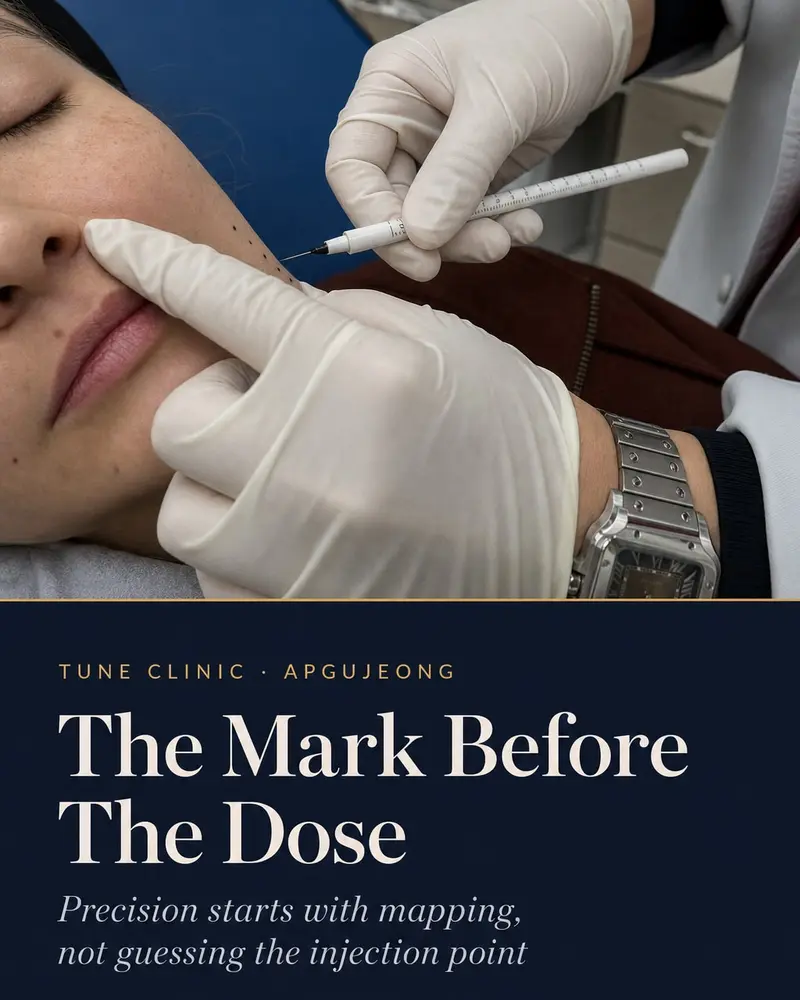
This is why we map the muscle before we calculate a dose — the anatomy decides the plan, not the other way around.
How Much Botox Is Used For Forehead vs Jawline vs Calf?
Unit ranges vary widely by area because muscle mass and treatment goal both change. Forehead treatments typically use a smaller unit count aimed at softening motion, while jaw, trapezius, and calf treatments typically use a higher unit count because the goal is measurable muscle-volume reduction over time.
Even within one area, the correct dose depends on the individual — muscle thickness on ultrasound-guided assessment, skin quality, and the patient’s own goal (subtle softening versus a more visible change) all shift the number up or down. We don’t work from a fixed chart; we work from what we see and feel on that specific patient, that day.
A jawline that looks “undertreated” at three weeks is often not undertreated at all — masseter reduction is gradual, and judging it on week one is judging an unfinished result.
What Does Botox Actually Do Differently In Each Area?
Botox has one mechanism — temporarily reducing muscle activity — but the visible effect changes depending on what that muscle does. In the forehead, less activity means fewer dynamic lines. In the jaw, trapezius, and calf, sustained reduced activity over repeated sessions leads to gradual muscle-volume shrinkage, which is what changes the outline.
This is also why timelines differ. Forehead softening is usually visible within days. Jaw, trapezius, and calf reshaping unfolds over several weeks and often needs a second session at three to four months to consolidate the change — one session rarely produces the full outline shift patients expect from before-and-after photos online.
Duration Also Differs By Area
Forehead results typically last three to four months. Muscle-reduction areas — jaw, trapezius, calf — often show longer-lasting outline change once the muscle has been trained down over two or more sessions, though the muscle can rebuild with time and repeat treatment is expected, not a sign of failure.
Who Should Not Get Botox In These Areas?
Botox is not the right tool for every jawline, shoulder line, or calf concern, because not every case is muscle-driven. A squared jaw caused mainly by bone width or fat rather than masseter bulk will not change meaningfully with Botox. A trapezius that looks broad due to posture or fat distribution needs a different assessment altogether, and calves shaped by fat or fluid rather than muscle bulk will not respond to a muscle-relaxing injection.
We also advise against jaw or calf Botox in patients who rely heavily on that muscle for function — very active chewers or athletes with high calf-strength demands may not be ideal candidates, or may need a more conservative dose. Pregnancy, breastfeeding, active infection at the injection site, and certain neuromuscular conditions are standard exclusions across all four areas. Sometimes the honest answer is that the concern isn’t muscular at all, and Botox — regardless of area — isn’t the fix. Structural facial planning for jaw and lower-face outline is covered in more depth on our physician-led design approach.
FAQ
How many units of Botox are needed for jaw slimming?
Jaw slimming for masseter reduction typically uses a higher unit count than forehead treatment, and the exact number depends on masseter thickness assessed in consultation. Results build gradually and most patients need a second session around three to four months later to reach the intended outline.
Does calf Botox work for everyone?
Calf Botox works best when the calf’s bulk is primarily muscular rather than fat- or fluid-driven, which is assessed before treatment. Patients with high functional demand on the calf muscle, such as certain athletes, may need a more conservative dose or may not be ideal candidates.
How long does trapezius Botox last?
Trapezius Botox for shoulder-line reduction typically shows change over several weeks rather than days, and the reduced muscle bulk can last a number of months before the muscle gradually rebuilds. Repeat sessions are generally required to sustain the silhouette change.
Is forehead Botox dosed the same as jaw Botox?
No. Forehead Botox uses a smaller unit count aimed at softening a thin expression muscle, while jaw Botox uses a higher unit count aimed at reducing a thick chewing muscle’s bulk over time. The mechanism is the same; the muscle and the goal are not.
Can Botox be combined across multiple areas in one visit?
Yes, forehead, jaw, trapezius, and calf Botox can be planned in the same visit when each area is assessed individually first. Combining areas doesn’t change the per-area dosing logic — each muscle is still mapped and calculated on its own before any injection is given.
Ready to plan your treatment?
Tune Clinic Apgujeong offers English-language consultations with Dr. Ju and Dr. Cha — a structured assessment, not a sales call.
→Book an appointmentto pick a time that fits your Seoul itinerary.
→Message us on WhatsAppto ask in English before you commit.