On this page
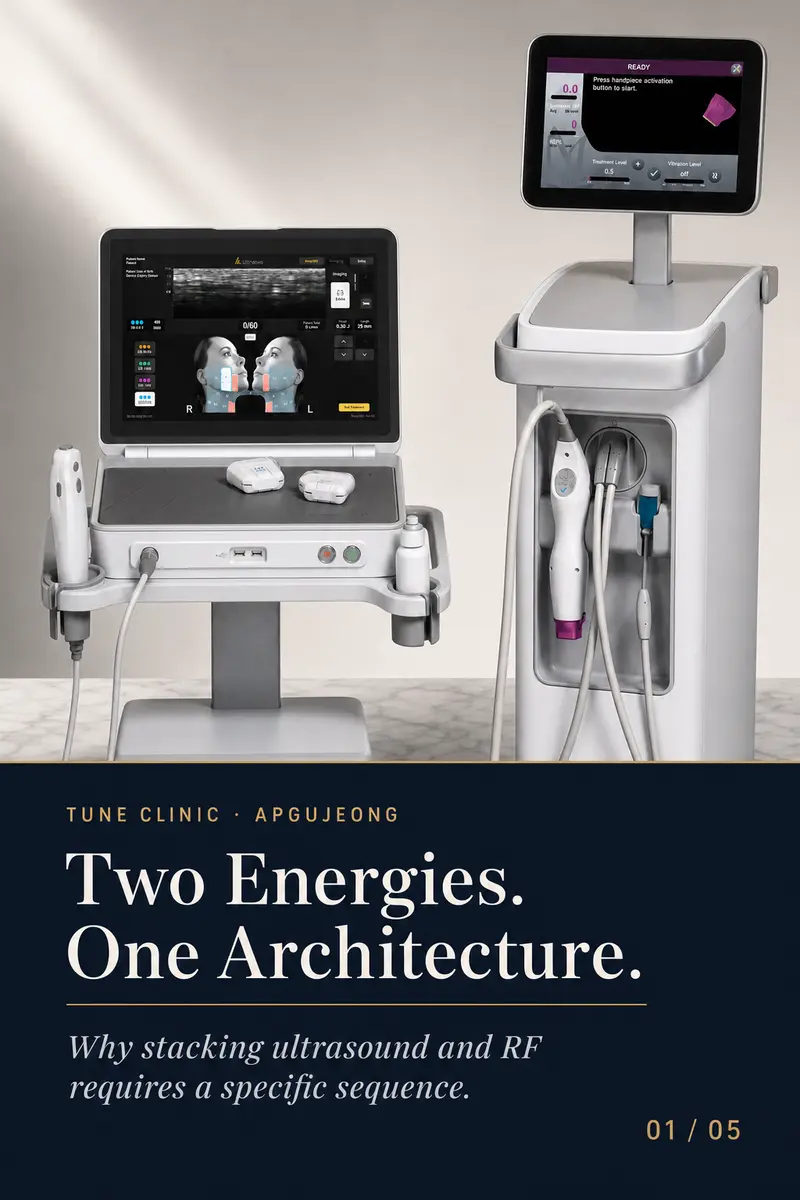



Combining ultrasound and radiofrequency energy in a single treatment plan is not additive by default — it depends entirely on sequence, depth targeting, and the order in which each modality is applied. Ultherapy addresses structural tissue at the level of the SMAS and deep dermis; Thermage FLX works through monopolar radiofrequency to remodel collagen density in the dermis and subcutaneous tissue. Used together in the right order, they address layers that neither device reaches alone. Used without a tissue map, they produce redundant energy delivery and, in some cases, competing thermal effects that limit the result of each.
Why Depth Determines Which Device Does What
Skin is not a single substrate. From the surface inward, it moves through the epidermis, papillary dermis, reticular dermis, subcutaneous fat, and — where lifting is the goal — the superficial musculoaponeurotic system, or SMAS. Each layer has different mechanical properties, different collagen architecture, and a different response to thermal injury.
Focused ultrasound, the energy behind Ultherapy, can be precisely deposited at 1.5 mm, 3 mm, and 4.5 mm depths. At 4.5 mm, it reaches the SMAS — the fascial layer that surgical facelifts address mechanically. The thermal coagulation points created there stimulate fibroblastic activity and, over the following months, a measurable degree of tissue tightening at a structural level.
Thermage FLX works differently. Monopolar radiofrequency conducts heat volumetrically through tissue, with peak energy concentration designed for the reticular dermis and the dermal-subcutaneous junction. Its effect on surface texture, skin density, and the quality of the dermis as a substrate is distinct from what ultrasound achieves at depth.
Choosing between Ultherapy and Thermage is often the wrong question. The more precise question is: which layer is underperforming, and which tool addresses it?
What Is the TenSera + TenTherma Protocol?
TenSera and TenTherma are the protocol names Tune Clinic uses for Ultherapy and Thermage FLX respectively within its Signature Lifting framework. The distinction is not cosmetic naming — it reflects a specific sequencing logic.
In a combined session, Ultherapy is applied first. The rationale is mechanical: delivering focused ultrasound into tissue that has not yet been thermally altered by RF preserves the acoustic properties the transducer depends on for accurate depth targeting. Introducing significant dermal heat before ultrasound delivery can, in principle, affect the tissue homogeneity the imaging component relies on. Sequence protects precision.
Thermage FLX follows, addressing the dermis and surface layers after the structural work is complete. The radiofrequency pass at this stage is not redundant — it targets a different thermal endpoint in a different anatomical zone.
Physician-Mapped Tissue Assessment
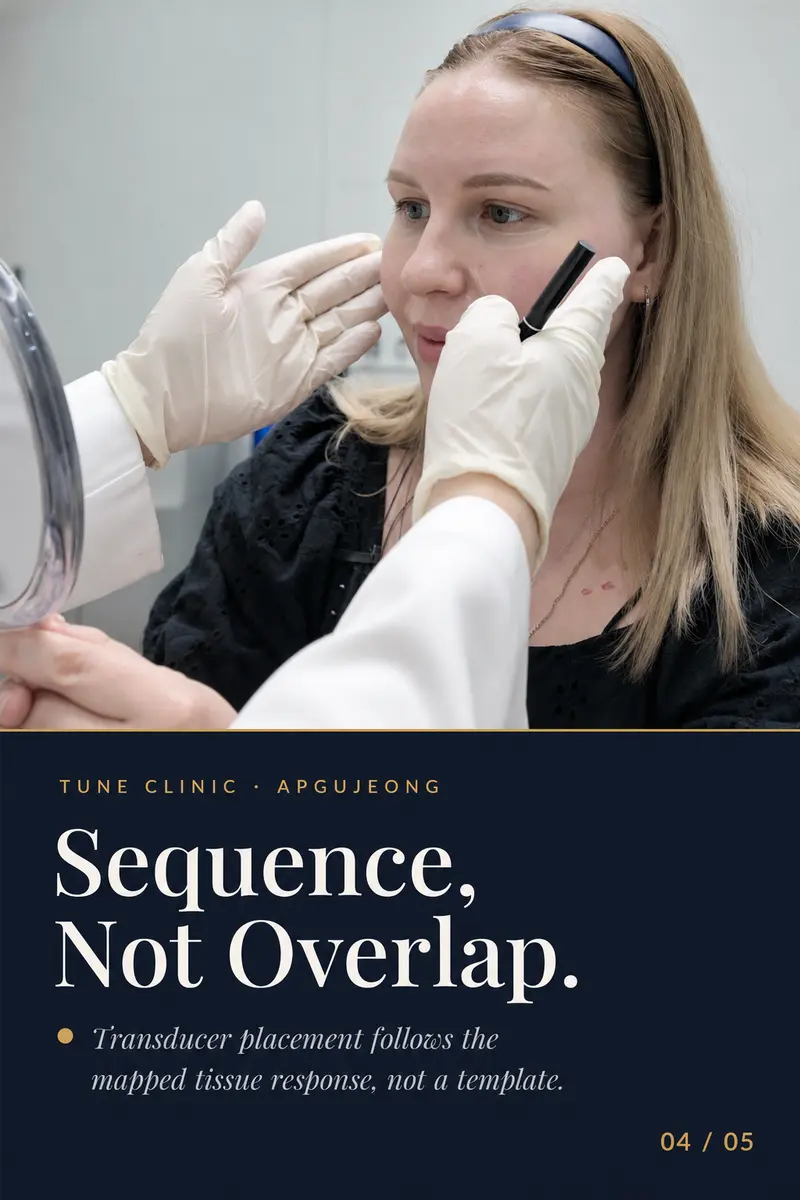
Neither device is applied to a standardized template. Before a combined protocol is planned, the treating physician assesses tissue laxity, the quality and mobility of the SMAS, fat compartment volume, and the current density and quality of the dermis. In patients with significant ligamentous laxity or advanced fat compartment descent, adding energy to a structurally compromised foundation produces limited returns. In those cases, the conversation about what energy can and cannot do becomes part of the consultation itself.
Transducer selection for Ultherapy — which depth, which pass pattern, how many lines — follows that assessment rather than a default count. The same principle applies to Thermage FLX parameters.
Does Stacking Two Devices Always Make Sense?
Not always. A younger patient with early dermal laxity and reasonable SMAS integrity may benefit from a single-modality approach. A patient with primarily surface textural concerns — skin quality rather than structural position — may be better served by Thermage FLX alone, or by pairing it with an injectable like Rejuran or Juvelook to address the dermal substrate directly.
The TenSera + TenTherma combination is most clinically appropriate when there is genuine work to do at both the structural and dermal levels — when SMAS-depth tightening and surface collagen remodeling each have a meaningful role in the outcome. That determination comes from the physician assessment, not from the patient’s preference for a comprehensive-sounding protocol.
Combination energy treatments also carry a higher cumulative thermal load. Recovery expectations, interval timing, and aftercare protocols differ from a single-device session. These variables are addressed in the consultation before any treatment is scheduled.
How to Think About Results and Timeline
Neither Ultherapy nor Thermage FLX produces immediate final results. Ultherapy’s structural effect develops over roughly three to six months as the thermal coagulation points resolve into new collagen. Thermage FLX’s dermal remodeling follows a similar timeline, though early improvements in skin texture are often visible sooner.
In clinical experience, patients who undergo a properly sequenced combined protocol typically see a progression — early surface improvement followed by a deeper structural result that becomes apparent at the three-month mark. Sustaining that result over time depends on maintenance intervals that vary by individual tissue behavior, not a fixed annual schedule.
FAQ
What is the difference between Ultherapy and Thermage FLX?
Ultherapy uses focused ultrasound to deliver precise thermal energy at specific depths, including the SMAS — the structural layer beneath the dermis. Thermage FLX uses monopolar radiofrequency to heat the dermis and subcutaneous tissue volumetrically, targeting collagen density and skin quality rather than deep structural position. They work on different layers and produce complementary rather than identical effects.
Why does sequence matter when combining ultrasound and RF?
Ultrasound imaging and depth targeting depend on consistent acoustic properties in the tissue. Applying significant radiofrequency heat to the dermis before ultrasound delivery can alter those properties. Performing Ultherapy first preserves the tissue environment the transducer needs for accurate placement, then Thermage FLX addresses the surface layers once the structural work is complete.
Is a combined Ultherapy and Thermage treatment right for everyone?
No. The combination is most appropriate when there is clinically meaningful laxity at both the structural and dermal levels. Patients with primarily surface concerns, or those with structural conditions better addressed by surgical or thread-based approaches, may not be ideal candidates. A physician assessment of tissue quality, ligament laxity, and fat compartment position is necessary before recommending any combined protocol.
How long does it take to see results from TenSera + TenTherma?
The full effect develops over approximately three to six months as collagen remodeling progresses. Some early improvement in skin texture may be visible within weeks of treatment, but the structural lifting effect from Ultherapy and the deeper dermal remodeling from Thermage FLX both require time. A follow-up assessment at three months helps gauge the tissue response and plan any subsequent treatment.
Can energy-based lifting replace filler or threads?
Energy-based devices and injectables or threads address different mechanisms. Ultherapy and Thermage FLX stimulate the body’s own collagen response; they do not replace volume or reposition descended fat compartments mechanically. In patients with significant volume loss or ligamentous descent, a physician may recommend combining energy treatments with structural support from threads or volumizing injectables rather than relying on energy alone.
Ready to plan your treatment?
Tune Clinic Apgujeong offers English-language consultations with Dr. Ju and Dr. Cha — a structured assessment, not a sales call.
→Book an appointmentto pick a time that fits your Seoul itinerary.
→Message us on WhatsAppto ask in English before you commit.